Google

YouTube

Spotify

Scientific Sense Podcast

Tuesday, June 25, 2013

Entropy driven evolution

Although many explanations exist for the origin of life – mostly from traditional religions, the most robust scientific explanation is the one driven by entropy. A singular direction of time coupled with unambiguously increasing entropy in the universe, point to life as a mechanism that accelerates entropy. Those wondering why a group of complex chemicals will get together and act in unnatural ways, could consider the existence of a simple objective function as the maximization of entropy from available means. In other words, life is the most efficient way to accelerate entropy given a chemical condition.

Evolution, then, could be explained in the same vein. If more complex life forms increase entropy at faster rates, then, there should be a natural push toward the creation of such life. Simpler life, should lead to more complex ones and this is fundamental to evolution. However, from a system perspective, if such a transformation leads to aggregate loss in entropy creation – either due to volumetric loss of simpler life or constraints placed on them by evolving complex ones, then, evolution can lead to suboptimal performance. Since the physics of entropy cannot be refuted, it has to be that complex life is fully capable of compensating for any loss of entropy creation from entities they evolved from. The evolution of the brain, a highly inefficient organ, in mammals, certainly fits the bill.

Evolution, may be better explained by physics, as a process that accelerates the entropy of the universe

Friday, June 21, 2013

Single City

A recent study from the Santa Fe Institute shows that cities are excellent systems – they are efficient social reactors and networks. As they grow, they make larger and denser social webs available to each participant, without any additional effort from the individual. The study does not suggest any diseconomies to scale and maximum limits.

Conceptually, then, the larger a city is, the better. This implies that the best design for humanity is to establish a single city that houses all of the World’s population – about 7 billion currently. To reduce extra-terrestrial risks from such a concentration, perhaps a second city can be established, at a location diametrically opposite to the first one. The second city, a mirror image of the first, could be left vacant for emergency use only. With distributed 3D printing, conventional manufacturing can be eliminated. Power production can be designed at mega scale with concentrating solar and wind farms away from the city, with efficient transmission back. Vertical farming may allow food production in close proximity. Excess power production may ultimately eliminate the need for farming, with instant conversion of power to food or direct consumption of energy instead of food.

With a single city design, most of the World can be returned to its original state. Such a system will have higher diversity and associated flexibility to mend itself after shocks.

Sunday, June 16, 2013

Predictive scans

A recent study funded by the National Institute of Mental Health shows that brain scans before and immediately after the initiation of a treatment hold valuable information to predict efficacy. Both the discovery and the practice of medicine, still, largely depend on trial and error. Multi-factorial complex responses of the biological system to CNS therapies have resulted in significant noise in the collected behavioral data – creating havoc both in R&D and in healthcare providers, not to mention the payers. The process of inventing and applying medicines for mental health seem fully antiquated in the presence of available technologies.

Pharmaceutical R&D and healthcare, albeit being technologically advanced in certain dimensions, have been lagging in the analysis of available information. PET scans, an old technology, show brain activity in highly analyzable matrix, providing an almost instantaneous path to measure efficacy of a drug. Such scans may also provide a method to determine optimal dose, something that researchers were forced to ignore. The 7 billion specimens of humans across the world show such genetic diversity that it seems unlikely that popping a standardized amount of the NCE within standardized time intervals, will be optimal treatment.

It is time both R&D and the practice of medicine embraced the tools of analytics – something boring engineers have been accustomed to for many decades and it has resulted in handsome returns.

Saturday, June 15, 2013

Democratic network

Recent research from the City University of Hong Kong and the School of Management, at Beijing Normal University, shows that the click stream is not dominated by a few hubs – but rather smaller and relatively unknown websites could have significant influence on network traffic. The basic notion of scale – still a dominant theme of strategy for consulting firms and business schools alike - has been irrelevant for over two decades. Somehow, the PowerPoint gurus of corporate board rooms, have been a bit slow in recognizing it. And, they have been successfully draining shareholder value in fees and escaping before the owners are able to recognize the scheme.

Two basic ideas – content is important and people are not stupid – have escaped many. The “hubs” - some perfecting algorithms through neural nets trained to seek cat videos and others spawning cloud capacity like escaping water from the Amazon, may have missed the mark. Scale does help you but it is not a life saver. Content is more important and increasingly content is inversely correlated with scale. As the knowledge content of society increases, business models based on legacy ideas and those frozen in time – either mesmerized by monopoly profits or just sheer ignorance, are bound to fail. Such enterprises, akin to autocratic regimes with little understanding of optimal polices, are now run by people who have lost touch with reality. As they yahoo themselves to mediocrity, some demanding physical presence at the workplace and others counting earnings per share – apparently believing it is the most important metric, there is life beneath.

Democracy – a concept that never fails to bring the best possible outcomes – will continue to dominate networks, societies and the universe.

Tuesday, June 11, 2013

Complex stability

Recent research from the University of Southampton shows a mechanism that self-stabilizes complex systems – such as the Earth’s environment. When the system and its participants are affected, a control system emerges to stabilize the environment. This has implications for many different systems including the financial markets and large companies.

If the financial system is akin to a self equilibrating complex system, that would mean that it is more likely to mend itself after shocks. This means that there is a strong mean reversion in asset prices after shocks. This will challenge the assumption that asset prices follow random walk and this may cast doubts on the efficient market hypothesis. Similarly, predictions of the demise of large and complex companies are premature as unknown mechanisms appear to sustain them and their participants even though most do not demonstrate competitive advantages outside monopoly power.

In general, it appears that the higher the complexity of a system, the more likely that it nourishes self-equilibrating control systems that kick in after shocks. Complexity could be a valuable survival trait for inefficient and naturally unstable systems.

Monday, June 10, 2013

Mathematical language

Recent research from the University of Texas demonstrates how Markov logic chains could be used to assign a probability of “closeness” of a word or phrase to a paraphrase. This appears to finally break the shackles of determinism and prescriptive rules in natural language processing. Decades of lull in artificial intelligence could be attributed to those trying to ram a square peg into a round hole. Chess and Jeopardy have given certain technologies respect they do not deserve. More importantly, research in that direction holds everything back. It is unclear if computer scientists will ever accept that intelligence is not rules based.

Intelligence, however, is not rules based. Engineers with traditional training find it hard to move away from this concept just as the business students who were given antiquated methods to determine the value of something, fail to consider alternatives. This is a significant failure of the education system that appears to favor the past and discount the future. Why else would we have people in venerable companies stuffing rules into hardware in an attempt to beat a human or business students who adorn spreadsheets with numbers neatly adding up, down and sideways as if it means something. Language is a good example of chaotic outcomes that start with simple patterns. Incremental addition of random noise renders it completely incomprehensible to those with linear brain waves.

If the education systems are not able to catch up with the present, we may be fast approaching a regime in which education has negative value.

Sunday, June 9, 2013

Fast decisions

Recent research from the Laboratory of Behavioral Ecology and Evolution at Seoul National University demonstrates that birds, specifically magpies, make fast decisions based on human gaze. Clearly, selection advantages have provided them with the ability to both collect and process information from human gaze efficiently. Although the human gaze, on the surface, appears to be a binary phenomenon – present or absent, it is possible that the birds may be using finer details of the available information in the decision processes.

If the speed of decision-making is a skill that is passed on from generation to generation, then, it should point to observable differences in the bird brain. If the skill has been improving over time, then, it is unlikely that it is an acquired skill. If the structure of the brain, indeed, is changing, it is interesting to think about what is happening in the case of humans. The speed of decisions was critical early in human evolution but it seems less important now. If evolution did select for speed, then the current crop of humans are thrust into an unfamiliar environment. Excluding certain war situations, video games and financial trading (that is largely taken up by computers), the quality of decisions is more important than the speed of making them. In other words, the magpie that is able to discern finer shades of human gaze by analysis may ultimately win the game. 

Trigger happy Homo-sapiens may have been successful in eliminating slower Neanderthals but one has to wonder if this is another evolutionary quirk, that resulted in sub-optimal outcomes.

Friday, June 7, 2013

Stress-less belief

Research from the University of Oxford, recently reported in the Journal of Experimental Social Psychology demonstrates that “the belief in science,” increases with stress. In trials where subjects were known to be stressed in the experimental group compared to the control, they found that the stressed group are more likely to agree with seemingly innocuous statements such as “the scientific method is the only reliable path to knowledge.” This points to the general observation that it is “belief” that acts as the stress reducer. An equal number of people may be using “the belief in religion” in a similar vein.

This makes sense from an evolutionary perspective. Early days of homo-sapiens were not pretty – animals and cannibals were hunting them down and stress was the primary attribute of living. One had to believe to survive, for without it, everything looked bleak. Burdened with a powerful organ, an evolutionary quirk, humans could look forward and see a worse tomorrow. The uncertainty was constant and they were completely ill-equipped to survive in the environment they were afforded. The elements reduced them to less than a few thousand – before inexplicable luck launched them higher from near extinction.

Stress has been with humans ever since. And survival, thus, selection depends much on how to reduce stress. Belief has become a critical defense mechanism in this battle. They started believing in inanimate objects that resembled something. As society developed, they moved onto legends and stories – that will someday morph into organized religion. Then, science arrived – with similar but potentially superior constructs that could explain what is observed. It slowly ate into the market share of the dominant provider of belief – religion. Science, however, could never appeal to the masses as belief is not about explaining the present - it is more about obscuring the future. The inability of science to give meaning to ignorance will likely hold it back for ever.

Believe to reduce stress – it does not matter what one believes in.

Monday, June 3, 2013

Technology lift

A recent study from the Indian Institute of Technology, Madras argues that making cheap tablets available to millions in India may lift them out of poverty. This is a path worth pursuing as poverty is fundamentally driven by lack of access to information and capital. The competence and even desire can be shown to be uniform across the masses but market failures in information have held nearly 1/3 of the world’s population back and pinned them to incurable poverty. This is a shame for a civilization claiming to have made progress in virtually every dimension but has little to show for it.

Lack of access to information is the worst contemporary societal disease, as it leads to poverty, disease, crime and moral decay. As the leaders of countries across the world clamor to build and enhance physical infrastructure such as roads and bridges, they forget the leverage afforded by improved information infrastructure. The world has already moved on from the need for physical transport to mental engagement. With 3D printing around the corner, the trucks, trains and airplanes that carry physical goods are about to become obsolete. Further, with computer languages and mathematics rendering the world flatter than a pancake, the only advantage remains to be in information and knowledge.

If the IIT hypothesis holds good, then the distribution of millions of tablets across the country at $50 a piece, may usher in a wave of innovation. If the leaders of the country are serious about making a difference, here is a golden opportunity to run an experiment that cost nearly nothing. But then, one can never underestimate bureaucratic friction, corruption and sheer incompetence in policymaking, in a country, vastly famous for it.

Wednesday, May 29, 2013

The goal

What is the goal of an individual? With 7 billion people around the world with little genetic diversity but with a wide variation in perspectives, that include sex, country, language, religion, physique and science, the question is what one should attempt to optimize. In a zero order society such as ours where optimization is always local, it is a good thought experiment.

The problem presented, then, is related to the probability that humanity will pull itself to the next stage. It seems unlikely – diseases have to be cured, the environment has to be mended, happiness has to be restored, art and philosophy have to triumph over prescriptive engineering and science, money has to be abandoned, knowledge has to become the primary currency of transaction and meritocracy has to prevail. Yes, it seems unlikely, but many attempted to achieve much less in the past.

What is the goal for an individual in the precious amount of time she is afforded? Could she try to change the system, society and the culture that envelopes her – or should she simply drift away to obscurity, complying? Should she look around, see what others do not see, make others cannot make and progress thoughts, others cannot have?  Should she redefine who she is and in the process change humanity bottoms up? Should she challenge the status-quo or accept the preprogrammed outcomes? Should she become successful and then change the world or fail attempting early? Should she broker thoughts across time and space to connect and then disconnect?

What is the goal of an individual? Is it comprehensible?

Monday, May 27, 2013

Inflexible homes

A recent study from the University of Warwick statistically demonstrates what could be intuitively clear – policies that result in high home ownership reduces labor and location flexibility, leading to higher unemployment rates. This is an important observation. However, what the study may be ignoring is that the “job market” has changed and any analysis of historical data on jobs and location flexibility may not be valid.

Many are unwilling to own up to the fact that there are no more “jobs” in the conventional sense of the word. With advancements in 3D printing and communications technology, both manufacturing and services industries are being revolutionized. What matters most now are skills and not presence, creativity not political savvy, imagination not optimization and execution not meetings.Those seeking jobs and those who are attempting to hire, should seriously reconsider what they are tying to do. If having a home, ties somebody down to a location and that reduces her employability, then, she may be seeking the wrong job. Equally importantly, if the hiring manager, however yahoo great she might think she is, insist on the presence of the employee on location, may be simply missing the whole point.

Studying historical data is good – but doing so without the context of the changing world, may not be.

Saturday, May 25, 2013

Memories

As humans find ways to live longer – first comprehensively beating out the bugs and then tackling some autoimmune diseases – it appears that the brain is taxed more and more. It has been the workhorse, ever ready to monitor, maintain and occasionally think, but it was never designed to last this long. A quantum computer, no less, but constrained by its biological origins and lack of flexibility, the brain has been a puzzle to those who attempt to use it. It stores information but retrieves it less efficiently, allowing humans to be ordinary animals, inaccurately recollecting the past and happily speculating about the future.

Memories of the brain, then, are what sustain humanity and the loss of them is simply disastrous. As the sane departs into the folds of history, they take those precious memories with them as there is no cloud, with sufficient capacity, to store it all. What a tragedy that humans have not found a way to preserve their own memories as the loss of information from those leaving and those who left but yet alive, is infinitely costly. Housed in small spaces, the brain has been front and center to the tribulations of generations in the past and more yet to come, yet it shows flashes of brilliance and compassion with failed attempts at integration and introspection. What could be done to preserve its creative intentions, its ability to seek the truth, its actions to make things right, its attempts to resolve the past and its valiant attempts to forecast the future?

The brain, the final frontier, will likely elude humanity forever as they travel in deep space, accumulate wealth and fame, explain particles and energy, kill and mutilate in the name of religion and politics and assert superiority over the known universe.

Friday, May 17, 2013

Better, older..

Recent observations (1) from a binary star system that includes a neutron star dancing with a white dwarf, indicate that Einstein's general theory of relativity, nearly a 100 years old now explain the seen gravity waves, the best. This is further affirmation that the dark ages of science is prolonged, with no foreseeable end. Fancy theories and heavy steel never measured up to sheer intellect and imagination.

The real question for physicists is where they go from here. Now that the Higgs Boson is proven to be “true”, what is next? Perhaps, a more exotic version of the Boson or maybe another trip to the particle zoo to pick an unproven fantasy, that may require a bigger and more powerful atom smasher. In either case, the expected progress in knowledge is close to zero. Both status-quo education systems and the process of awarding research grants have to change substantially to make any difference here. Awards and prizes, mere nods to mediocrity, who strive to discover and publish, peer reviewed or otherwise, simply make the situation worse. Further, engineers clamoring for “bigger” and more interesting projects simply aid and abet useless experimentation.

It is time to return to paper and pencil, the forgotten art of thinking, instead of measuring.


Einstein's gravity theory passes toughest test yet. Published: Thursday, April 25, 2013 - 14:10 in Astronomy & Space

Friday, May 10, 2013

Morality

A recent article (1) proposes that the mere existence of markets substantially erodes moral value, subjectively defined as the willingness to save the life of a mouse (used in animal experiments) instead of receiving money by trading them. Further, the authors argue that multilateral markets adversely affect morality more than bilateral markets.

These are interesting observations. If one were to accept the definition of morality as the ability to reject money to save a life (of a mouse), then, lack of markets will certainly enhance it. For, without markets, one cannot transact and hence an individual with no access to markets will be unambiguously, the most moral. At the other extreme, with large multilateral markets – and at the limit, with instantaneous and unrestricted access to infinite markets, the proclivity of an individual to transact (for money or other such benefits) will be the highest. Such large markets will always reduce transaction costs and participants in these markets will always be less moral (according to the definition) than those with no or restricted access to markets.

The real question is how one should define morality. Is morality a property of the individual or does it depend on the environment presented to her? Does morality change with the context, space and time of the issue at hand? Is morality demonstrable and measurable? Is morality binary or continuous? Does morality differ across ethnic and geographical regions? Are moral people better and if so how? Is morality valuable to society, or is it costly?

It is always important to define what is being measured before setting out to measure it. Also, passive assertion of societal benefits from subjective constructs such as morality can lead to the wrong conclusions.

(1) Morals and Markets Armin Falk 1,*, Nora Szech 2,
1 Center for Economics and Neuroscience, University of Bonn, Bonn, Germany.
2 Department of Economics, University of Bamberg, Bamberg, Germany.

Friday, May 3, 2013

Analyze this!

A recent research demonstrates that application of machine learning techniques applied to brain activity in a dream state do well against activity found in waking responses to visual stimuli (1). In general, visual contents of dreams seem to correlate well with those observed when the brain is awake.

The brain, albeit being a non-linear quantum computer, harbors characteristics that could be understood by traditional techniques. Machine learning techniques have been improving although most are extensions of deterministic statistical methods, engineers have been using for many decades. The observation that even such a crude technology is able to correlate brain states is encouraging and it may imply that the practice, if not the theory, of the brain is understandable. Research into biological and artificial intelligence progressed along opposite directions with little in common. The ability to build robust models from brain patterns that do well in predictions in different brain states could open a path toward collaboration among experts in these different areas.

Convergence in technologies and ideas is the most powerful concept yet. Segmented research is increasingly less productive.

(1) Neural Decoding of Visual Imagery During Sleep
T. Horikawa1,2, M. Tamaki1,*, Y. Miyawaki3,1,†, Y. Kamitani1,2,‡

Thursday, May 2, 2013

Shutting down the brain

Recent research from UCLA demonstrates that rats require less brain power in a virtual reality than in real world. This is an interesting observation. Although the UCLA experiment defines virtual reality in a narrow sense, one could broaden the concept. Conceptually, humans with routine lives are in a sort of virtual reality that requires less brain power to live in and thrive. Such a programmatic life is the norm for most, following traditional careers.

The larger question is whether such an effect has evolutionary implications. If the probability of success is higher when you find yourself in a virtual reality – a repeating game with less volatility – then they are more likely to be selected. Most large companies of today fit the bill. This means that the skills to adhere and optimally shut down parts of the brain that are not useful are the most valuable. If so, it is possible that humans may slide down the brain power curve as they evolve. The brain, already a highly expensive organ consuming 20% of available energy, can only be justified if it is fully deployed. Why buy a super computer if all one needs is a PC running a spreadsheet?

We may be precariously positioned in the evolutionary process, that never led to optimal outcomes in the past. The most likely outcome appears to be more brawn and less brain – a return to the origins for humans.

Thursday, April 25, 2013

Disconnected

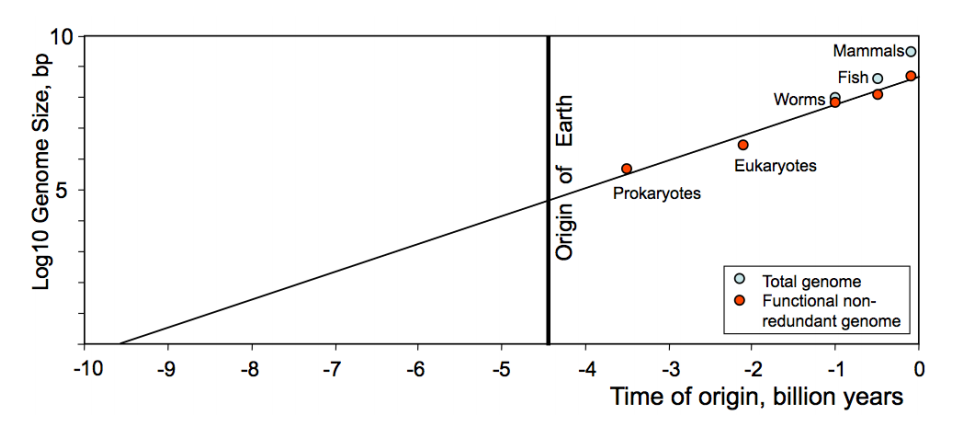
Recent research from Cornell University hypothesizes that life in the universe may have originated 9.5 Billion years ago. The authors, Alexei A. Sharov and  Richard Gordon do this by looking at trends on Earth and using a linear regression against the Log of the Genome size – a measure of complexity. See the chart below.

This has several implications.

First, with a universe only 13.7 billion years old and suffering from an initial violent epoch dominated by QSOs, this observation means that life initiated at the first available opportunity – just 4 billion years after the inception of the universe. As the solar system does not demonstrate any advantages over numerous other alternatives, it is likely that life originated across the universe, 10 billion years ago.

Second, the only known life progression has taken nearly 10 billion years to reach a level of complexity that aids interstellar communication capabilities. If this relationship holds in the universe, then the complexity of life everywhere may be approximately the same as what is found on Earth. Current capabilities of humans to communicate thru interstellar space are primitive. With similar expected capabilities elsewhere, the chance of a contact is close to zero. Further, current theory allows a very limited window of space-time for possible communications and that further constraints this possibility.

Finally, this observation makes it clear that life arrived in the solar system from outside – perhaps just 4.5 billion years ago. The visitors already harbored sufficient genetic complexity and spread highly successfully. What is not known, however, is whether the progression could have been different given different conditions.

Extra-terrestrial life has been a fascination for humans from the beginning. It appears that the effort expended in this direction is a waste of time. Humans may be better off focusing on how to protect the Earth and borrow sufficient time to evolve into something, bit more interesting.

Monday, April 22, 2013

Quantum efficiency

Recent research from the University of Chicago hypothesizes that quantum coherence may play an important role in the highly efficient conversion of energy in photosynthesis. This is an exciting fundamental finding that may open the doors for the creation of efficient and possibly organic solar cells. This further illustrates that most life, including plants, have figured out how to practically use quantum effects.

Humans are heavily handicapped – as they seek to improve incrementally based on well established frameworks. Most of what we proudly hold as true, are irrelevant and in most cases send us on dead end pursuits. There are enough signs that technologists are on a wrong track to boredom – but they are shackled by an antiquated education system and their prospective employers are chasing next quarter's earnings. This spiral – well constrained by the established notions and status-quo structures, can have only inferior outcomes.

It is ironic that humans are the last ones to the quantum party.

Saturday, April 20, 2013

Fine tuning emptiness

Recent findings that the universe is older, is expanding slower and it harbors more dark matter than energy compared to what was previously thought, are attempts at fine tuning a model, most are unwilling to let go. The basic idea that the inhabitants of a space-time bubble could not understand the system that governs itself, appears to have been lost. Only imagination, not experiments, has any chance of breaching that hard constraint.

Knowledge, then, could only come from philosophy and imagination, with science and technology delegated to noise created by those who do not perceive the constraints. Ironically, science is most apt at showcasing the constraints even though the underlying theories valiantly attempt to surpass them. There was a fork on the road – perhaps couple of centuries ago - when humanity eagerly marched down the scientific route, that was predetermined to win the tactics but lose the plot. The question is whether there is a possibility of convergence of the different ideas to substantially expand knowledge. That will require an integration of contrasting belief systems – science and philosophy, included.

Not all hope is lost – As a beautiful mind remarked nearly a century ago - “Logic will get you from A to B, but imagination will take you everywhere.”

Thursday, April 18, 2013

Bidding bias

A recent article in the Journal of Consumer Research shows that when the bidders are unaware of the characteristics of their competition, they are likely to bid more aggressively – possibly indicating inefficient price outcomes. Although the study was done on bidding in the social channels over tangible products, the finding has implications for the financial markets as well.

By definition, the originator of a bid price on a financial asset in a liquid market does not know the characteristics of the counter-party. Does this mean that there is a built-in positive upward bias (aggressive bidding) in the prices of financial assets? The article does not seem to explain if there is an asymmetry – i.e. are the sellers of assets, equally aggressive, when they are lacking such information? And without that, it is difficult to conclude anything.

However, the finding seems to imply that transaction prices are less efficient when the buyers are sellers are unaware of the counter-party characteristics. An exchange, thus, may induce a level of inefficiency into transactions. This is an interesting area of research and if straight bartering has a higher probability of establishing efficient prices, then, it may have some policy implications.